Saturday, October 27, 2012

Things in the Sky

Wow, it’s been a while since we visited the blogosphere.  Maybe we were just waiting until we left the atmosphere in our space unit?  Or maybe we have just been super busy . . .   Anyway, we’re back and here to tell you about what’s been going on in our classrooms for the past month.

After our family unit, we studied communities and did a lot with community helpers.  Then we took our first “trip” of the year.  We called the unit “Things in the Sky”, and we studied weather, seasons and clouds.  We got busy (Isn’t it crazy how busy October gets?!) and didn’t blog about that part of our unit.  But we did want to include an anchor chart and great way to attack a difficult strategy.  During our study of weather and clouds, we focused on the asking questions strategy.  This is definitely a tough one for students, especially first graders.  So we made anchor charts that showed different types of questions.  The Café Book by Gail Boushey and Joan Moser suggests trouble-shooting strategies.  They recommend using plans for questioning laid out by Taffy Raphael.  If you Google her name, lots of information about the four types of questions come up.  We used those for our teaching.  We also used the “Into the Book” website (http://reading.ecb.org/index.html).  It has some great activities and videos that show kids how to use the questioning strategy.

With each read aloud, we planned questions of each type.  Then we wrote them on sticky notes and put them in the book.  As we got to each questions, we read them aloud and the students had to identify which type of question it was before answering it.  Here is an anchor chart just about the weather questions from the books we read in the unit.


Here is an anchor chart that just has the strategies on it.  This has proven very effective.  Our kids are still referencing it and identifying questions as one of the four.  We hope that as they become even more comfortable, they more regularly ask the different types of questions on their own.


We changed our literature tree with the change of units.  We read several of Cynthia Rylant's Henry and Mudge books - the ones about seasons like Puddle Trouble and Sparkle Days.  The students each made a Mudge then wrote their names and their favorite season (i.e. "___ and Mudge's favorite season is summer.") and added a seasonal decoration.


After the weeks on weather we blasted off to outer space!  During the week that we studied space, we read lots of non-fiction books and really worked on main idea and details.  We spent one day each on the sun, the moon, the stars and the planets.  Here is an anchor chart that shows how we explored space and identified main ideas and details in the books we read.

We also read a book (And I can't for the life of me remember what tht title was, but as soon as I can think of it, I'll add it!) about building a rocket out of shapes.  Then the kids created their own rockets and labeled them.  They also wrote descriptive paragraphs in the style of the book about their rockets.
 
In one of the Smart Centers, the students used stars and different sized circles that we punched out of construction paper to create a solar system.

Our Reading Response Journals are a favorite Friday afternoon activity, and they are turning out so cute!  At the end of our Space unit, we read Poor Pluto written by the third grade students at Tokay Colony Elementary School in Lodi, California.  It’s a great story, and our students loved that kids not much older than them wrote their own book!  In the response journals, they students wrote whether or not they think Pluto should be a planet.  (Trying to get them started on opinion writing.  Gotta get those Common Core Standards covered!)  Then they glued a circle into their journals and added either a happy or sad face, depending on their opinion.  Here’s what they came up with (clockwise from top left): Pluto should be a planet because it is a part of a family.  Pluto should be a planet because it has been a planet.  Pluto should be a planet because is it part of the Solar System.  Pluto should be a planet because it belong up out of space.

Sunday, September 23, 2012

We are Family!

Since the beginning of the school year, we have been working hard to create school families in our first grade classrooms.  But for the past two weeks, we shifted our learning to our own unique families.  It was an easy transition to make – The students still get to talk all about themselves (Their favorite topic!) and we continue to teach important concepts through familiar content.

During the first week we started a new anchor chart about families.  We added a column to our standard “can/have/are” chart because we talk so much about what families “like to” do.  The students loved sharing what they like to do with their families, and we loved hearing about all their adventures!  One of my favorite responses was that families are “important” and “different”.  I love how deep these first graders are thinking already!  Towards the end of the week, the students made their own anchor charts during our writing block.  It was a great way to explore a new purpose for writing.


Throughout the two weeks, we created a word collection of family words.  Each morning, we brainstormed words starting with each letter of the alphabet to add to our boxes.  The students came up with some great words, and we let them add them to our collection as long as they could justify it being a “family word”.  We really loved what they said for m, n and o.   They said we should write “no” for n because moms always say no.  Then we needed to add “maybe” to m because moms sometimes say that too.  Finally, they said we needed to write “ok” in o because every once in a while moms do say ok. 


We read one of our favorite books about families – The Relatives Came by Cynthia Rylant.  We loved reading about all the fun the extended family had together.  The students could definitely relate!  They made text-to-self connections in one of their “Smart Centers” (We’ll post about these later, but in the meantime check out April DeCesare’s site about “Smart Schools".)  We called this one “Book Smart”.

In another Smart Center, Family Smart, the students responded to Loreen Leedy’s Who’s Who in My Family? by creating their own family trees.  The photos make it hard to see, but they wrote names of family members on each apple.

One of our favorite homework assignments of the school year happens during this family unit.  At the beginning of the unit, we send home a plain piece of white construction paper with some simple instructions – Have each family member trace his/her hand on the paper and sign his/her name.  The students then get to share with the class hat makes their families unique and special.

By the second week of our family study, we started talking about the roles of specific family members.  During our interactive read alouds where we review as well as introduce new CAFÉ strategies, we read books like What Aunts Do Best and What Uncles Do Best by Laura Numeroff, 31 Uses for a Mom and 33 Uses for a Dad by Harriet Ziefert and The Ultimate Guide to Grandmas and Grandpas by Sally Lloyd-Jones.  In the Family Smart center this week, students decorated a house with the chores or jobs that individual family members have.

In Ms. Arbogast’s room, we had to take a little time-out during the second week of our study to review some classroom procedures.  Maybe the honeymoon came to an end, maybe it was the low barometric pressure, but we had some  . . . let’s just say interesting behavior going on.  So, we read another great book about families, Alexander and the Terrible, Horrible, No Good, Very Bad Day by Judith Viorst, and designated a sort of cool down spot in our classroom.  The spot is located in our classroom library, out of view of the other students but in plain view of me, and is appropriately called “Australia”.  After setting some ground rules, it is my hope that students can use this spot to remove themselves from the action, calm down quickly and join the rest of the class refocused and ready to go.  (And that it doesn’t see too much action!)

We continued to work on Reading Response Journals on Friday afternoons.  We read The Napping House by Audrey Wood, and the students wrote about what they take to bed with them.  These say “I sleep with 2 dolls and 1 elephant.” and “I sleep with my dog."

This past Friday, we read A Chair for My Mother by Vera B. Williams.  The students pasted a jar and used thumbprints to represent the coins.  Then they wrote about what they would do with money they saved.  These say “I would use my coins to buy [a] house.” and “I would use my coins to buy a big bed.”  Thank you again, First Grade Parade for the great ideas for Reader’s Response!


Friday, September 7, 2012

Fabulous Friday

It has been a busy week in first grade! Since it was the first week of September, we kicked off our monthly home reading programs. Each child was given a reading log to take home to record what they read and how long they read each night. At the end of the month, we will total the number of minutes they read and for every 60 minutes read they will earn either a ticket (Ms. Arbogast's class) or a bead (Ms. Shivers's class). These tickets and beads will be on display in the classroom (see below) and will be a fun way of tracking reading progress throughout the year. Students will also be able to earn tickets or beads for meeting different reading challenges in class, such as moving up a reading level. We got the idea here and adapted it to fit our own classrooms!


Ms. Shivers's board is the one on the left. The beads will be collected on the students' luggage tags. Ms. Arbogast's board is on the right and the students' tickets will be added to their ring of tickets.


We have also continued practicing routines and procedures, and we introduced two new journal routines this week, reading response journals and math journals.

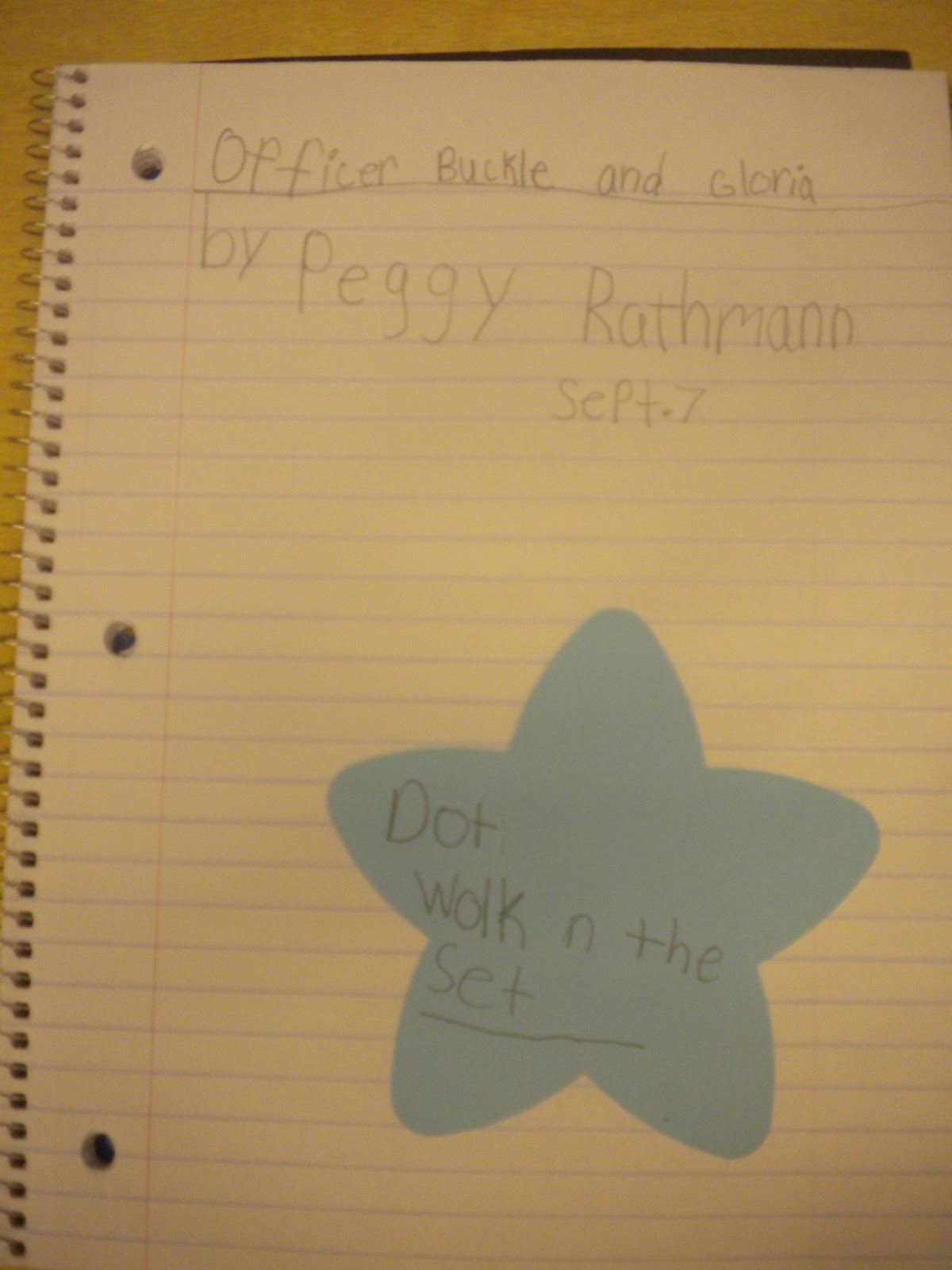
Every Friday we will choose one of the books we have read during the week to respond to in our journals. We got the idea here and are so excited to start this routine in our classes this year. The journals will be a wonderful way to show growth throughout the year and will make a great first grade keepsake! This journal offers the students a great opportunity to practice several writing and reading skills...capitalizing the words in a title, capitalizing the author's name, underlining the title, neat handwriting, finger spaces, etc. It also allows the students to have a chance to make a personal connection to their reading. Today we read Officer Buckle and Gloria.  The students always begin by writing the title, author, and date. We modeled this first on the ENO board and then the students copy it into their journals. Then the students chose their favorite safety tip from the book, wrote it on a star cut out and glued it into their journal. Here is a peek into a few of their journals:


From top left, clockwise: " Don't walk in the street.", "Stay away from guns.", "Never sit on a thumbtack.", "Don't smoke cigarettes."  There were so many cute ones, it was hard to choose just a few to share! :)

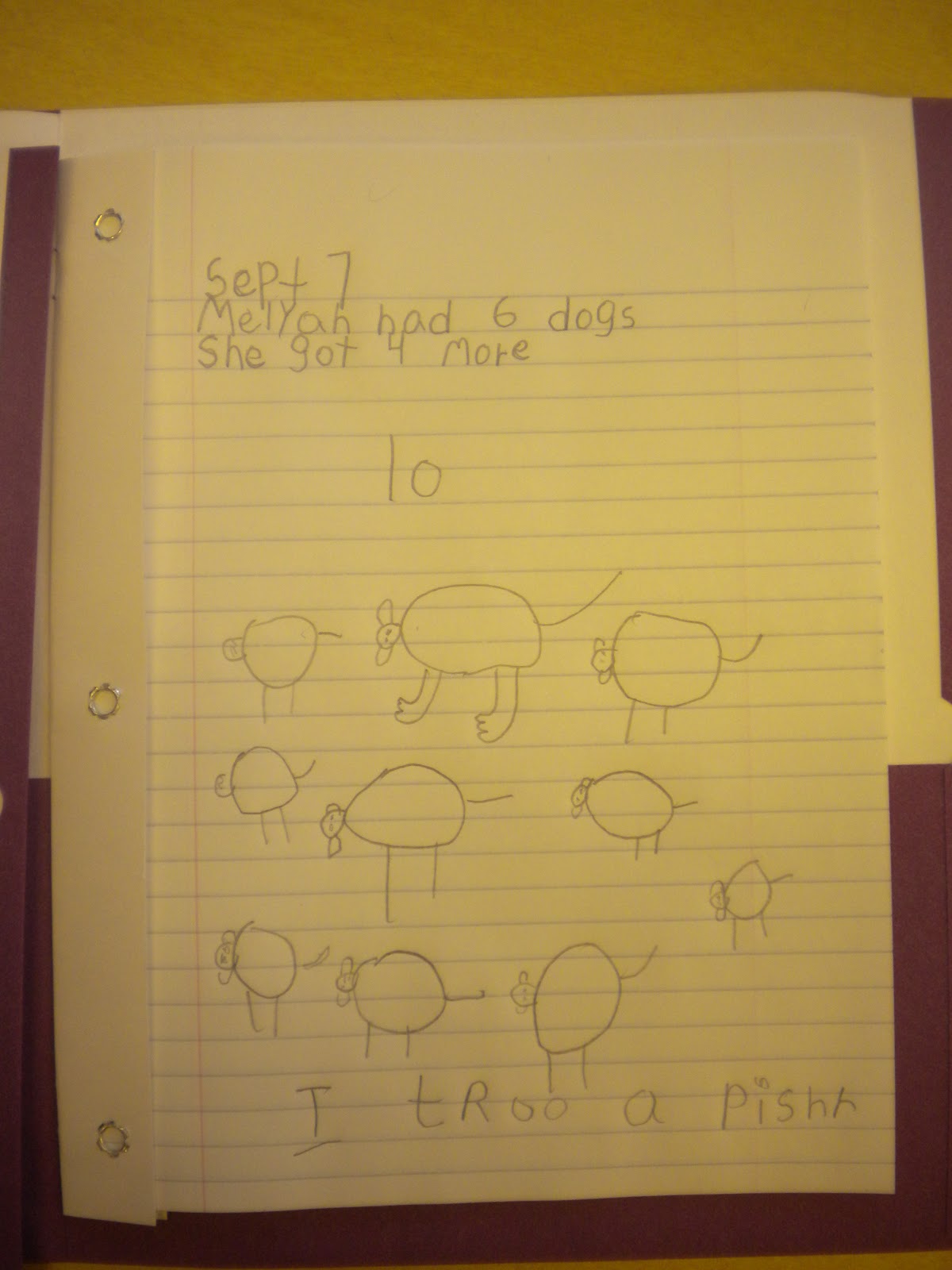
Finally, we also started our math journal routine today. Our math journals are going to be a place where we really extend our thinking. Besides solving the problem, the students will be asked to explain how they solved it and what strategies they used.  Today we just started with a simple number story. The students copied the problem, solved it, wrote an answer, and then wrote a sentence telling which strategy they used. In the future, we will probably give the students the problems already typed to glue into their journals to make it easier on everyone! They did great, though, for the first day and it will be exciting to see how these journals help them go deeper in their thinking throughout the year! Here are a few from today (I love the invented spelling in the second one! We will be working on that "dr" blend this year!):


Wow! We did so much this week, there just isn't room to share it all! Next week we will be beginning our "Family" unit! Have a great weekend!

Tuesday, September 4, 2012

Elephant and Piggie


An important goal of ours is to create a true classroom community.  That’s why we spend a few weeks at the beginning of our year focusing on friendship.  We kicked off our friendship unit this year with lots of books and activities based on Mo Willems’ Elephant and Piggie books.  The students think the books are hilarious, and we have so much fun reading them! 

The speech bubbles have been a great way to introduce point of view.  We even did our own shared writing with speech bubbles.  After reading Watch Me Throw the Ball, we asked the students what they can do.  The students answered, “Watch me . . .”


Then we read I Am Going, and the students shared places they like to go. 


Throughout the week, we practiced reading in a sort of call-and-response form, all the while tracking as we read.  It has been great practice and a fun way for the students to share with the class about themselves - their favorite topic, of course!

We also used Elephant and Piggie to do our first character study.  We got some great ideas from this packet from “What’s the Buzz in First” on TpT.  We created an anchor chart for the characters.  The students came up with lots of great characteristics that describe Elephant and Piggie.


We also made paper plate Geralds and Piggies.  The students loved using their paper plate puppets to act out and retell their favorite stories.  (I wish I had save some of theirs for a photo.  They did such a great job!  But I sent them home, so you’ll have to see what mine look like.)


Coming up, we are going to focus on the character traits of good friends using more of these wonderful books.  We got some great ideas from “The World of Elephant and Piggie”.    

Tuesday, August 28, 2012

The First Few Days


Well, we have survived the first few days of first grade! And first, we just want to say… Wow! Air-conditioning makes all the difference in the world! It was one of the smoothest starts we have had and the fact that the little ones were not melting from the heat definitely helped them to settle in quickly!

We spent the first three days on routines, routines, and more routines! In between all of the routines we filled in the time with several of the wonderful activities from Abby’s Fun with Firsties back to school packet. While all of the activities were great, Jitter Juice was definitely the most popular! The kids LOVED it! To go along with the idea of first day jitters, we also read The Teacher from the Black Lagoon. After reading, we let the kids on a secret: teachers get nervous too! So we wrote our first class book in which the teacher is nervously waiting for her students and imagines all of them as monsters. The students wrote their name in the sentence frame “_____is a monster” and then drew a picture of themselves as a monster. They loved imagining what they could look like as a creature from the black lagoon. It also helped those quiet, shy ones realize that it was okay to be nervous because their teacher was nervous too!


On Friday, we kicked off our hallway book tree project with reading the David books. We discussed being a peacemaker vs. peacebreaker and then each student made their own David to hang on the tree. They turned out so cute! However, we can’t take credit for the idea. We got it from Cara at The First Grade Parade, who got the idea here.


Now it’s a new week and while we are still drilling those routines, we have also kicked off our friendship unit with Elephant and Piggie! Those loveable characters from Mo Willems are already a hit with the students! More from that unit to come soon!

Tuesday, August 14, 2012

Word Collection Boxes

Another vocabulary building, reading project-inspired idea is “Word Collection Boxes”.  This also comes from The Cafe Book by "the sisters", Gail Boushey and Joan Moser.  For each theme or unit, we will choose a few important vocabulary words and post them on our “Word Station” (leftover from our days of Four Blocks and Word Walls but works with our travel/adventure theme).  As we finish the unit, we will decide, as a class which few words are most important and we want to remember.  We will add those to our Word Collection.

At first, we will do this as a class.  But eventually we hope that students will choose which words are most important to them and record them in their own word collections.

Wonderful Words


Over the summer, we took a class called Kentucky Reading Project.  What a great two weeks!  The class was so informative and gave us so many awesome and practical ideas.  A part of the class was writing a Literacy Action Plan based on our school’s test scores.  We’ll meet with our cohort a couple times throughout the year and share our projects with teachers from throughout the state in March.

Our plan was all about building vocabulary.  We already teach a systematic phonics program, and we are working on writing.  But our kids seem to struggle with vocabulary.  One project that we are hoping will help build their word banks is our “Wonderful Words!” wall.  The bulletin board is in the first grade hallway, and we are hoping to get all seven first grade teachers involved.  A couple times each week, we will decide on a theme (i.e. school supply words, animal words, sports words, anything goes!).  Each teacher will wear a word on her back on a certain day.  For example, if the theme is school supplies, we will each wear a word like pencil, scissors, eraser, etc.  Of course, many of these words are already posted in our rooms.  Initially, we want the students to practice reading our own rooms and transferring that information to other places.  Later, we’ll get into various themes and content areas.  The idea is that when we study animals, for example, students might be able to read and define “bird” but not cardinal, robin or blue jay.  Then the first student, whether from our own classroom or not, to correctly read and define the word will be able to illustrate it.  Then we will collect all the words, pass them from room to room and eventually display them on the wall.

We are still brainstorming ideas for reviewing and properly practicing the words after they are posted . . .

Update: Here are the first two sets of words.  So far, the students are really into "Wonderful Words Wednesday" and they work hard to read as many teachers' words as possible!